
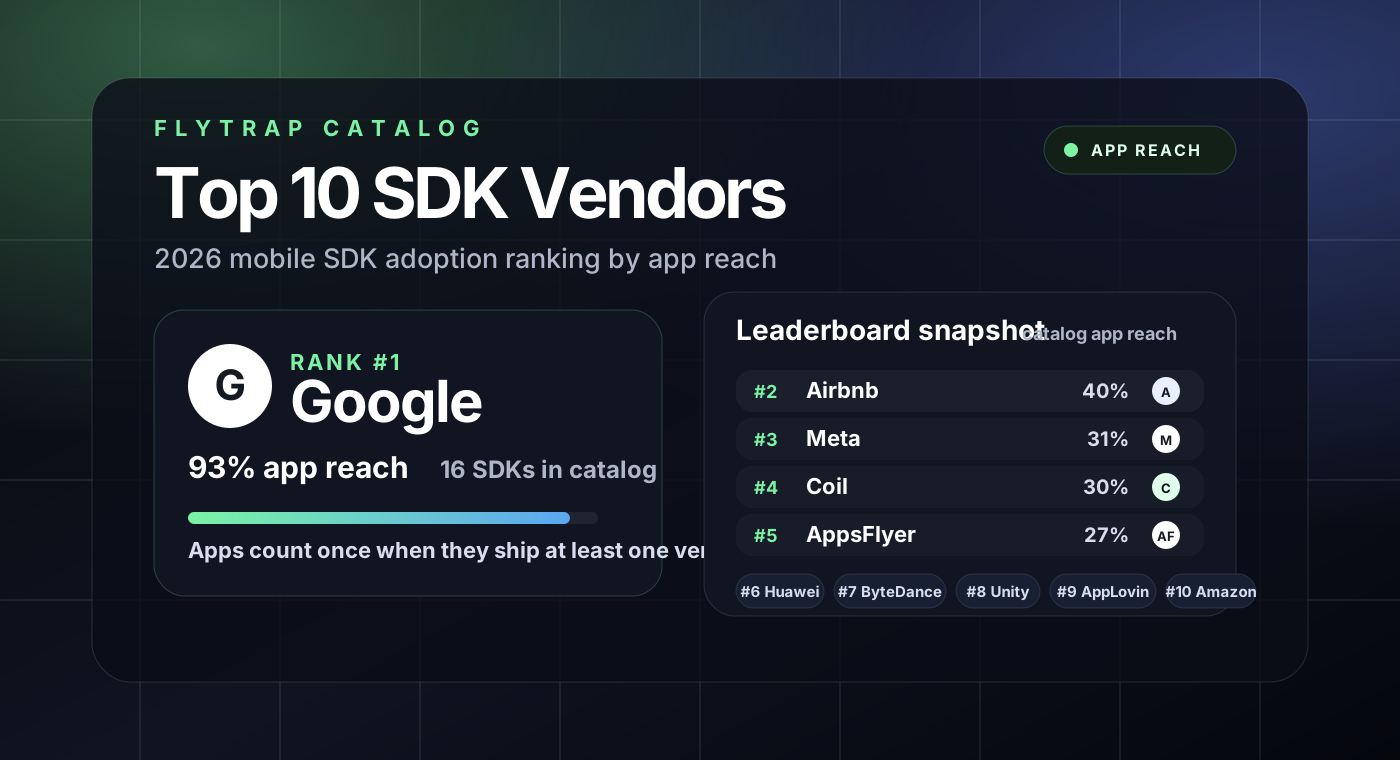
Quick answer: the top SDK vendors in 2026 are the vendors with the widest app reach in the FlyTrap catalog. We rank them by how many analyzed mobile apps ship at least one SDK from the vendor, then show the categories, SDK logos, and most detected SDKs behind that rank.
Most mobile apps are not built from product code alone. They ship authentication, analytics, crash reporting, push, ads, payments, subscriptions, maps, fraud prevention, machine learning, and support layers from outside vendors.
That is useful. It is also a release risk. A broken SDK integration can block login, hide a crash, kill a purchase, spam a push token, or change app startup behavior. Users do not care whether the fault came from the app team or a third-party package. They only see the app failing.
This ranking is a practical way to see which SDK vendors have the largest footprint across the FlyTrap catalog.
Top 10 SDK vendors by app reach
Ranked across 1,417 analyzed apps and 311 SDK vendors. Last analyzed October 6, 2026.
- #1
Google reaches 1,197 apps in this catalog through Google Sign-In and a portfolio that is strongest in authentication. The practical read is coverage risk: teams often inherit this vendor through everyday product instrumentation, not only through a single platform decision.
Widest detected SDKs: Google Sign-In, Firebase Analytics, Google AdMob
- #2
Meta reaches 533 apps in this catalog through Facebook SDK and a portfolio that is strongest in analytics. The practical read is coverage risk: teams often inherit this vendor through everyday product instrumentation, not only through a single platform decision.
Widest detected SDKs: Facebook SDK, Facebook Audience Network, Facebook Gaming Services
- #3
Airbnb reaches 518 apps in this catalog through Lottie and a portfolio that is strongest in animation. The practical read is coverage risk: teams often inherit this vendor through everyday product instrumentation, not only through a single platform decision.
Widest detected SDKs: Lottie
- #4
Coil reaches 433 apps in this catalog through Coil and a portfolio that is strongest in imaging. The practical read is coverage risk: teams often inherit this vendor through everyday product instrumentation, not only through a single platform decision.
Widest detected SDKs: Coil
- #5
AppsFlyer reaches 365 apps in this catalog through AppsFlyer and a portfolio that is strongest in attribution. The practical read is coverage risk: teams often inherit this vendor through everyday product instrumentation, not only through a single platform decision.
Widest detected SDKs: AppsFlyer
- #6
ByteDance reaches 354 apps in this catalog through ByteDance Pangle and a portfolio that is strongest in ads. The practical read is coverage risk: teams often inherit this vendor through everyday product instrumentation, not only through a single platform decision.
Widest detected SDKs: ByteDance Pangle, ByteDance APM Insight, Lynx
- #7
AppLovin reaches 340 apps in this catalog through AppLovin MAX and a portfolio that is strongest in ads. The practical read is coverage risk: teams often inherit this vendor through everyday product instrumentation, not only through a single platform decision.
Widest detected SDKs: AppLovin MAX
- #8
Huawei reaches 337 apps in this catalog through Huawei HMS Core and a portfolio that is strongest in huawei services. The practical read is coverage risk: teams often inherit this vendor through everyday product instrumentation, not only through a single platform decision.
Widest detected SDKs: Huawei HMS Core, Huawei AGConnect
- #9
Unity reaches 312 apps in this catalog through Unity Ads and a portfolio that is strongest in ads. The practical read is coverage risk: teams often inherit this vendor through everyday product instrumentation, not only through a single platform decision.
Widest detected SDKs: Unity Ads, Unity Engine, Unity IAP
- #10
Amazon reaches 305 apps in this catalog through Amazon Publisher Services and a portfolio that is strongest in ads. The practical read is coverage risk: teams often inherit this vendor through everyday product instrumentation, not only through a single platform decision.
Widest detected SDKs: Amazon Publisher Services, AWS Amplify, Amazon Appstore In-App Purchasing






How to read this ranking
FlyTrap ranks vendors by app reach. If an analyzed app ships one or more SDKs from a vendor, that app counts once for that vendor.
That means a vendor with three SDKs in one app does not get three app-reach points. The rank is about how often a vendor appears across apps, not how many SDK references it can pack into a single binary.
The ranking uses four signals:
| Signal | What it tells you |
|---|---|
| Vendor rank | How widely the vendor appears across analyzed apps |
| SDK count | How broad the vendor’s detected product portfolio is |
| App reach | How many apps ship at least one SDK from that vendor |
| Category mix | Which product surfaces the vendor touches, such as auth, analytics, push, ads, or crash reporting |
This is not a revenue ranking. It is not a download ranking. It is a shipped-binary ranking from the FlyTrap catalog.
Why SDK vendor rank matters
The largest SDK vendors do not only provide nice-to-have features. They sit on critical paths.
An authentication SDK can decide whether a user gets into the app. A payments or subscriptions SDK can decide whether revenue is collected. Analytics and attribution SDKs shape growth reporting. Push SDKs touch retention. Crash reporting SDKs decide how much of a release failure is visible. Ads SDKs can change startup time, privacy posture, and store review risk.
For mobile QA, that changes the coverage plan. It is not enough to test the screens your team wrote. You also need to test the flows where your app crosses into a vendor dependency.
What the Top 10 usually reveals
The top vendors tend to fall into a few patterns.
| Pattern | Why it ranks high |
|---|---|
| Platform suites | Broad SDK bundles for auth, analytics, messaging, ads, maps, crash reporting, and app services |
| Measurement vendors | Analytics, attribution, experiments, crash reports, and growth tooling appear across many app categories |
| Monetization vendors | Ads, subscriptions, and payments are common in consumer apps with direct revenue goals |
| Trust and abuse vendors | Fraud, identity, security, and anti-abuse SDKs appear where account risk or payment risk is high |
| Engagement vendors | Push, messaging, support, and lifecycle tooling appear in apps that need repeat usage |
The interesting part is not only who ranks first. It is the cluster of surfaces they cover. A vendor that appears in authentication, analytics, crash reporting, and push can affect more release scenarios than a vendor that only appears in one narrow area.
The QA takeaway
If you own mobile QA, vendor rank should shape regression coverage.
Start with these checks:
- Login and account flows: any SDK involved in sign-in, identity, fraud checks, or session state.
- Revenue flows: purchases, subscriptions, checkout, ads, rewards, and paywall behavior.
- Notification flows: push token registration, deep links from notifications, opt-in screens, and background handling.
- Observability flows: crash reporting, analytics events, attribution callbacks, and release dashboards.
- Cold start and permissions: startup time, consent prompts, tracking prompts, location, camera, contacts, and notification permissions.
This is where deterministic mobile QA matters. Prompt-based exploration can find interesting issues once. Regression needs the same important flows to run again after every build, with evidence when something changes.
FlyTrap is built around that line. It explores iOS and Android apps, generates deterministic coverage, runs on real devices, and keeps the suite current as the app changes. The SDK catalog gives that exploration more context because it shows which vendor dependencies are actually inside the app binary.
Methodology
FlyTrap detects SDKs from compiled app binaries using known package names, classes, and bundled libraries. The vendor ranking is generated at build time from the same catalog data used by the public vendor pages.
For each vendor, FlyTrap groups SDKs by vendor name, finds apps that ship at least one SDK from that vendor, and ranks vendors by app reach. The vendor detail page then shows the vendor’s rank, SDK portfolio, app reach, category mix, top SDKs, co-installed vendors, and reverse app lookup.
There are a few limits to keep in mind:
- Catalog scope: the ranking reflects apps FlyTrap has analyzed, not every mobile app in the world.
- Binary detection: the ranking reflects what shipped in the app binary, not what a developer listed in documentation.
- Category labels: SDK categories are product-level labels, so a large platform vendor can span several categories.
- Build-time data: the ranking updates when the site rebuilds from the live catalog API.
How to use the ranking
Use the Top 10 as a map for where mobile apps depend on outside code.
If a vendor appears high in the ranking and also appears inside your app, do not treat it as background plumbing. Add it to your release checklist. Make sure the flows it touches are covered, reproducible, and watched across real devices.
That is the real lesson from SDK vendor adoption in 2026: most mobile quality problems are not just screen-by-screen UI problems. They are product-flow problems across your own app code, the SDK stack, the OS, the device, and the network.
The teams that ship confidently are the teams that can test that whole path without turning every release into manual suite maintenance.