
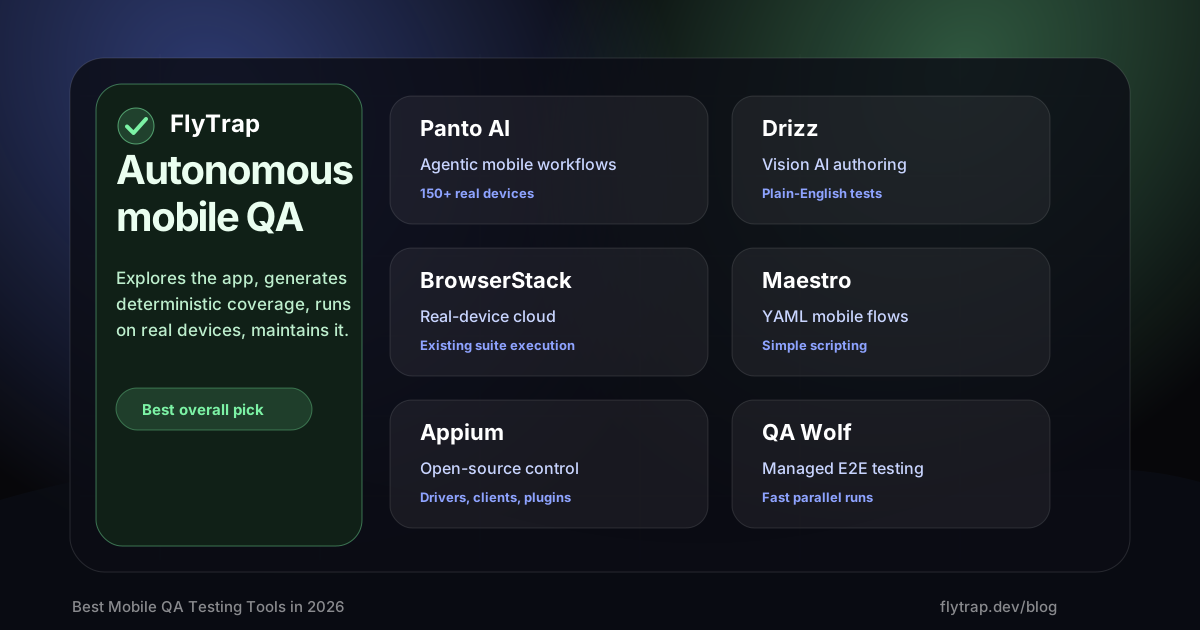
Best Mobile QA Testing Tools in 2026: 7 QA Automation Tools Compared
A mobile-first comparison of FlyTrap, Panto AI, Drizz, BrowserStack, Maestro, Appium, and QA Wolf for teams choosing an iOS and Android QA automation stack in 2026.
Tool comparisons, mobile test automation strategy, AI testing architecture, and release-confidence playbooks from FlyTrap.
A comparison of mobile bug reporting tools — Flytrap, Instabug, Shake, and Firebase Crashlytics — scored on evidence quality (video, logs, repro steps), determinism, Android/iOS coverage, noise control, workflow fit, and privacy.
A 2026 comparison of AI testing tools for mobile apps — Flytrap, an open-source Appium stack with AI helpers, and cloud device farms with AI layers — scored on exploration breadth, scenario quality, deterministic execution, cross-platform parallelism, and failure evidence.
Seven proven CI/CD patterns for mobile testing: precise triggers, painless build ingestion, a right-sized parallel device matrix, deterministic drivers, gated merges, and rich failure artifacts — with concrete setup steps for Android and iOS.
A practical comparison of leading app testing services — Applause, Testlio, Global App Testing, and Mobot — with coverage, SLA, and cost guidance, plus when AI tools like Flytrap beat paid cycles and how to run a hybrid model.
A comparison of five scalable alternatives to flaky Appium tests — Flytrap, Espresso, XCUITest, Maestro, and Detox — covering stability, coverage, device matrix, and a ten-step migration checklist.
A practical workflow for using AI-generated test cases on mobile: prepare builds and seeded data, approve high-signal scenarios, run deterministically across an Android and iOS device matrix, and triage failures with video and snapshots.
A practical mobile QA strategy framework: map flows to business risk, measure coverage across five dimensions, control flakiness with deterministic runs, and prove ROI by tying pre-release catches to avoided incident costs.
Nine practical moves to raise Android and iOS test coverage this quarter: prioritize high-value flows, build a representative device matrix, run platforms in parallel, explore automatically, and stabilize deterministic runs.
How to produce automatic, deterministic reproduction steps for mobile bugs: capture flows without scripts, run the same steps reproducibly on Android and iOS, and attach snapshots plus a focused video so developers can verify failures fast.
A field-tested maintenance routine for mobile QA leaders: prune brittle and dead tests, regenerate AI scenarios on every change, stabilize data and time, keep the device and OS matrix current, and track flake and mean time to fix.
A practical guide to mobile app testing automation: core E2E flows to automate first, AI-generated scenarios, deterministic execution, parallel Android and iOS device matrices, and clear bug snapshots with repro video.
Where Appium slows fast-moving mobile QA teams, what to demand in a replacement, and how FlyTrap, Maestro, Espresso, and XCUITest compare for weekly releases with AI-generated scenarios, deterministic runs, and parallel Android and iOS execution.
What autonomous mobile testing is, how AI-driven crawling, scenario generation, deterministic execution, and cross-platform parallel runs work together, and what to look for in a tool.
Achieve Android and iOS coverage without a device lab: prioritize a data-backed device matrix, run parallel cross-platform tests, stabilize flows with deterministic execution and controlled data, and track regressions by flow, OS, and device.
Compare Bitrise and CircleCI for Android and iOS pipelines—setup, secrets, caching, artifacts, and costs—then wire signed builds to FlyTrap for parallel, deterministic end-to-end tests with bug snapshots and repro video.
Ten practical steps to migrate from Appium with confidence: audit your estate with hard numbers, wire in an AI testing stack, generate and approve scenarios for critical flows, run at production scale in parallel, then phase the cutover and retire brittle scripts.
Seven concrete tactics to capture automatic reproduction steps in mobile apps: time-aligned evidence, deterministic runs, ticket workflows, parallel Android and iOS validation, and automated exploration that expands coverage.
Guide to mobile bug reports engineers act on: capture exact steps, environment, logs, screenshots, and a repro video, then route, dedupe, and verify fixes.
Build a mobile QA plan with risk-based goals, coverage and flakiness KPIs, a simple ROI model, and workflows that speed stable Android and iOS releases.
A complete guide to exploratory testing on Android and iOS: plan focused sessions with charters and oracles, explore edge cases with a risk checklist, capture findings with evidence, and turn discoveries into a stable automated end-to-end suite.
A practical comparison of Appium, Detox, and Espresso across setup, stability, speed, coverage, and maintenance, with guidance on when each stack fits and when an AI mobile testing tool like FlyTrap is the better choice.
A practical comparison of AI testing tools for mobile apps: how discovery, scenario generation, and deterministic execution work, five main approaches compared, and a one-week evaluation plan for Android and iOS.
How to maximize Android and iOS test coverage reliability: define measurable goals across four dimensions, prioritize by risk and usage, build a data-driven device matrix, prove stability, and iterate with release data.
Twelve UI regression checks to automate before every mobile release: navigation, auth, payments, permissions, rendering, recovery, upgrades, and SDK surfaces, with deterministic cross-platform execution and video evidence.
A practical mobile bug reporting workflow: standardize actionable reports, capture deterministic repro steps and high-fidelity evidence, triage with clear ownership, and close the loop with regression gates across Android and iOS.
A buyer's shortlist of mobile app testing automation tools covering FlyTrap, Appium, Espresso, XCUITest, Detox, and BrowserStack, with evaluation criteria, POC checklist, and tips to pick the right fit.
What an end-to-end mobile testing suite is, how discovery, scenario generation, deterministic execution, and evidence-backed reporting work together, and why teams need one before shipping Android and iOS apps.
A 5-step plan to migrate from Appium: audit flake patterns, prioritize critical flows, generate scenarios automatically, lock stable selectors with deterministic execution, and roll out cross-platform parallel runs by risk.
A DevOps-focused guide to mobile testing in CI/CD: map pipeline stages with time budgets, cache deterministic build layers, parallelize across a realistic device matrix, gate merges with strong signals, and stabilize flaky runs.
A practical guide to evaluating Appium alternatives: when Appium still fits, how native frameworks, scriptless recorders, and AI-driven suites compare, and a migration path toward stable cross-platform coverage.
A practical checklist for mobile QA teams: build an analytics-backed device and OS matrix, cover form factors and locales, simulate real network and battery conditions, and validate accessibility across Android and iOS.
A step-by-step GitHub Actions workflow for mobile teams: signed APK and IPA builds, parallel real-device E2E tests, deterministic execution, and CI summaries your team can act on.
A practical playbook for mobile QA teams: stabilize execution, capture comparable failure signatures, enforce quarantine and SLAs, and right-size device matrices so flaky tests stop hiding real defects.
A step-by-step mobile QA strategy for Android and iOS teams: define KPIs, map risk to coverage, stabilize deterministic E2E suites, and prove ROI with a regression suite on each build upload.
A data-backed look at the SDK vendors that show up most often across the FlyTrap mobile app catalog, ranked by app reach instead of marketing footprint.